
Michigan SOS Permit Practice Test 19
- Questions50
- Correct to pass40
- Passing score80%
- Minimum age14 years 9 months
-
1. Why is a shoulder check especially important on a road with motorcycles and bicycles?
Show answer
Answer D: A narrow vehicle can disappear completely in the blind spot
A motorcycle or a bicycle is small enough to be hidden entirely by a door pillar or by the blind spot the mirrors do not cover.
-
2. A yellow diamond shows two lanes narrowing into one. What does it require of a driver?
Show answer
Answer D: Adjusting speed and merging before the lane disappears
The lane ends sign gives notice that one lane will be dropped, so drivers should adjust speed and blend into the continuing lane in good time.
-
3. You want to turn left at an intersection with no signs or signals and a vehicle is coming straight toward you from the opposite direction. What must you do?
Show answer
Answer C: Yield and turn after the oncoming vehicle has passed
A driver turning left always gives way to oncoming traffic that is close enough to be a hazard, whether or not the intersection is controlled.
-
4. A school crossing guard steps into the roadway and holds up a stop paddle. What must you do?
Show answer
Answer D: Stop and stay stopped until the guard and the children have left the road
A crossing guard directs traffic with legal authority; you must remain stopped until both the guard and the children are clear of the roadway.
-
5. A sign at the approach to a bridge reads WEIGHT LIMIT 10 TONS. What does the figure set?
Show answer
Answer B: The heaviest vehicle the bridge may legally carry
A weight limit sign is a regulation based on what the structure can bear, and it applies to the loaded weight of the whole vehicle.
-
6. At a railroad crossing with no gates and no flashing lights, the crossbuck is normally combined with which sign?
Show answer
Answer C: A yield sign, or a stop sign where an engineering study calls for one
At a passive crossing the crossbuck forms an assembly with a yield sign, or with a stop sign when an engineering study or engineering judgment supports it, so the driver knows who must give way to the train.
-
7. You feel drowsy, so you open a window and turn the radio up. What does that achieve?
Show answer
Answer B: Very little, because the drowsiness comes back
Cold air and loud music are not sleep, so the alerting effect lasts a minute or two and the driver is soon just as sleepy and closer to a lapse.
-
8. Why is being thrown out of a vehicle in a crash so dangerous?
Show answer
Answer C: Because you strike the road or other objects at high speed, and rarely survive
Ejection is one of the deadliest outcomes of a crash, and a fastened belt is what keeps a person inside the vehicle.
-
9. Why are drivers required to turn the front wheels when parking on a grade?
Show answer
Answer A: So that a vehicle that starts to roll leaves the traffic lanes instead of entering them
The wheel position is a last line of defense if the parking brake or transmission fails, directing the vehicle into the curb or off the roadway.
-
10. Does Michigan require driver education for a resident aged 18 or older applying for a first driver's license?
Show answer
Answer B: No, driver education classes are not required at that age
Michigan does not require driver education classes for residents 18 and older; they take the knowledge test, obtain a Temporary Instruction Permit and then pass the driving skills test.
-
11. You arrive at an intersection with no signs, no signals and no markings at the same time as a vehicle on the road to your right. What must you do?
Show answer
Answer B: Yield to the vehicle on your right
At an uncontrolled intersection you must yield to a vehicle already in the intersection or approaching from your right.
-
12. You are driving on a two-lane road approaching the crest of a hill. Where should you position your vehicle?
Show answer
Answer D: Toward the right side of your lane, in case an oncoming vehicle is over the center line
You cannot see what is beyond a crest, and oncoming drivers sometimes drift across the center. Keeping right and slowing gives you a margin.
-
13. You are in a passing zone that continues over the crest of a hill ahead. May you start a pass?
Show answer
Answer B: Only if you can finish it well before the crest
Beyond the crest you cannot see oncoming traffic, so any part of the pass that happens there is being made blind.
-
14. You feel dizzy and get a headache while driving with the windows closed. What could be the cause and what should you do?
Show answer
Answer D: An exhaust leak letting carbon monoxide into the cabin, so open the windows and stop to get fresh air
Carbon monoxide is colorless and odorless, and headache, dizziness and drowsiness are early signs. Get fresh air at once and have the exhaust system inspected.
-
15. You are about to drive a rental car that you have never driven before. What should you do?
Show answer
Answer A: Adjust the seat and the mirrors and find the controls before moving off
Hunting for the wipers or the lights in traffic is a distraction, so learn the layout while the vehicle is stopped.
-
16. A person using a wheelchair is waiting to cross at a corner ahead. How should you treat that person?
Show answer
Answer B: As a pedestrian with the right of way at the crossing
A wheelchair or a mobility scooter user has the rights of a pedestrian, so yield the whole crossing and wait until the crossing is finished.
-
17. A rectangular marker with alternating black and retroreflective yellow stripes set at a slant is used to
Show answer
Answer C: mark an obstruction, with the stripes sloping down toward the side on which traffic should pass
This striped panel is an object marker, and the direction in which the stripes slope shows the driver which side of the obstruction to pass on.
-
18. Why is it often safer to back into a parking space than to back out of one?
Show answer
Answer D: Because you leave the space going forward, with a clear view
Backing into the space puts the difficult maneuver where you are stopped and looking around, and lets you drive out facing the traffic and pedestrians.
-
19. What is the minimum age to enroll in Segment 1 of Michigan driver education?
Show answer
Answer D: 14 years and 8 months
A Michigan teen must be at least 14 years and 8 months old to enroll in Segment 1, one month before the Level 1 License age.
-
20. A driver extends the left arm out the window and bends it upward at the elbow. What does this signal mean?
Show answer
Answer B: A right turn
The left arm bent upward at the elbow is the standard hand signal for a right turn.
-
21. Why should you avoid parking over tall dry grass or a pile of dead leaves?
Show answer
Answer B: Because the hot exhaust can set the dry material on fire
The exhaust system stays hot for a long time after a drive and can ignite dry vegetation underneath the vehicle.
-
22. You are parking facing uphill on a street with a curb. What is the correct wheel position?
Show answer
Answer B: Turn the front wheels away from the curb and let the vehicle roll back until a tire touches it
Facing uphill the vehicle would roll backward, so the wheels point away from the curb and the tire is rested against it to act as a block.
-
23. Why does even a small reduction in speed matter so much where people are walking?
Show answer
Answer D: Because a pedestrian struck at a lower speed is far more likely to survive
The chance that a pedestrian survives falls steeply as impact speed rises, so a few miles per hour can decide the outcome.
-
24. You stop at a rest area because you are sleepy. How long a nap is usually recommended?
Show answer
Answer D: About fifteen to twenty minutes
A short nap of fifteen to twenty minutes restores useful alertness without leaving the grogginess a longer sleep can bring, and you should wait a few minutes before driving on.
-
25. A yellow diamond showing a bicycle is posted on a rural road. What should a driver expect?
Show answer
Answer A: Bicyclists crossing or riding along the roadway there
The bicycle warning sign is used where a bikeway crosses the road or where riders are likely to be in the traffic lanes, so drivers should look carefully and pass wide.
-
26. How long must an adult in Michigan practice on a Temporary Instruction Permit before taking the driving skills test?
Show answer
Answer D: At least 30 days
An adult holding a Temporary Instruction Permit must practice under the supervision of a licensed adult driver for at least 30 days before taking the on-road driving skills test.
-
27. Can a driver be charged with impaired driving after taking a legal over the counter medicine?
Show answer
Answer C: Yes, if the medicine impairs the ability to drive safely
Impaired driving laws cover any substance that affects driving, including cold remedies, allergy pills and sleep aids sold without a prescription.
-
28. What civil fine does Michigan set for a basic violation of the move over law for stationary emergency vehicles?
Show answer
Answer C: 400 dollars
A move over violation involving an authorized emergency vehicle is a civil infraction carrying two points and a 400 dollar civil fine, with felony penalties when a responder is injured or killed.
-
29. An overhead lane-use control signal shows a steady red X above your lane. What does it mean?
Show answer
Answer B: You may not use that lane and must move out of it
A steady red X means the lane below it is closed to you, while a steady yellow X is the warning to prepare to vacate the lane and a downward green arrow means the lane is open.
-
30. A sign on a long downgrade points to a runaway vehicle ramp. What is that ramp for?
Show answer
Answer C: Trucks that have lost braking ability on the grade
A runaway ramp is an escape lane of loose material that stops a heavy vehicle whose brakes have overheated or failed, so it must always be left clear.
-
31. Traffic is heavy and crawling where a sign warns that your lane ends and two lanes must become one. What is the best practice?
Show answer
Answer C: Use the lane to the end, then take turns merging one by one
In stop-and-go traffic the zipper merge, using both lanes up to the merge point and then alternating, keeps the queue shorter and traffic moving; in free-flowing traffic move over as soon as it is safe.
-
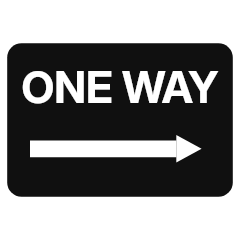
32. A driver disregards this sign and turns so as to travel against the direction it establishes. What is the immediate danger?
Show answer
Answer D: The driver will face traffic head on, because every lane comes the other way
Turning against the established direction puts the vehicle nose to nose with all the traffic on that street, which is why the mistake has to be corrected at once.
-
33. A streetcar is coming along tracks in the middle of the street as you wait to turn across them. What should you do?
Show answer
Answer A: Let the streetcar pass before you cross the tracks
Rail vehicles cannot steer around you and need a long distance to stop, so drivers yield to a streetcar or light rail train.
-
34. On an overhead guide sign, the small exit number panel sits above the left-hand end rather than the right. What does that placement tell you?
Show answer
Answer A: The exit leaves from the left side of the roadway
The exit number plaque is placed on the side from which the ramp leaves, which gives advance notice of the unusual left-hand exit.
-
35. What happens when alcohol is combined with another drug that also affects the nervous system?
Show answer
Answer B: Impairment is often far greater than either one alone would produce
Combined substances can multiply each other's effects, producing impairment well beyond what a driver would expect from either one taken separately.
-
36. Another driver cuts you off and you feel your temper rising. What should you do?
Show answer
Answer A: Take a breath, drop back and let it go, because the whole trip matters more
Retaliation turns a moment of bad driving into a crash, and dropping back costs you only a few seconds.
-
37. You are circulating in a roundabout and a vehicle is waiting to enter ahead of you. What should you do?
Show answer
Answer D: Keep going, because circulating traffic does not stop for entering vehicles
Stopping in the circle to be polite surprises the drivers behind you and defeats the design; entering traffic is the side that waits.
-
38. May a Michigan driver overtake a bicycle inside a marked no-passing zone?
Show answer
Answer A: Yes, if it is safe to do so
Michigan expressly allows a driver to overtake and pass a bicycle in a no-passing zone when it is safe to do so.
-
39. The cars in front of and behind your parallel parked car have left you very little room. How do you get out?
Show answer
Answer D: Ease back and forth, turning the wheels each way, until you clear
Short movements with the wheels turned first one way and then the other walk the car out of a tight space without touching anything.
-
40. At what level of apparent property damage must a Michigan crash be reported immediately to police?
Show answer
Answer A: 1,000 dollars or more
A driver involved in a crash that injures or kills anyone, or that damages property to an apparent extent totaling 1,000 dollars or more, must report it immediately at the nearest police station or to the nearest police officer.
-
41. What must a driver be ready to do along the stretch of road where this sign is posted?

Show answer
Answer D: Slow down and stop for a child who steps into the roadway
Children misjudge speed and distance and act without warning, so the driver reduces speed, covers the brake and scans the sidewalks and parked vehicles.
-
42. May you park across the entrance to a fire station?
Show answer
Answer D: No, an emergency exit must never be blocked
Emergency vehicles must be able to leave the moment a call comes in, so their entrances and exits are kept clear at all hours.
-
43. At roughly what speed can hydroplaning begin when a lot of water is lying on the road?
Show answer
Answer C: At speeds as low as about 35 mph
With enough water and less than perfect tread, a tire can start to ride on the water at around 35 mph, well below normal highway speeds.
-
44. You see a shield for a three-digit Interstate whose first digit is even. What does that tell you about the route?
Show answer
Answer C: It loops around a city and rejoins its parent route
A three-digit Interstate beginning with an even digit is a loop or beltway that connects back to the main route at both ends, while an odd first digit marks a spur.
-
45. A vehicle is sitting in your blind spot and you need to change into that lane. What should you do?
Show answer
Answer B: Adjust your speed to open a clear gap, then check again and move over
Changing your speed either drops the other vehicle behind you or lets it move ahead, which turns the blind spot back into open space.
-
46. May you use a relative's accessible parking placard to park in a marked accessible space?
Show answer
Answer D: No, only when the placard holder is being transported in the vehicle
A placard belongs to the person, not to the car, so it is valid only when that person is being transported; using it otherwise takes a space from someone who needs it.
-
47. Why should you stay out of an intersection you cannot clear, even on a green light?
Show answer
Answer B: Because you would block cross traffic when their signal turns green
A vehicle stranded in the intersection blocks the cross street when its light turns green, which stalls the whole junction and traps emergency vehicles.
-
48. Why should heavy objects in the passenger compartment be secured?
Show answer
Answer A: Because loose objects fly forward in a crash and can injure the people
Anything loose keeps traveling at the speed of the vehicle when the vehicle stops, so it strikes the occupants with great force.
-
49. A parking space is marked with the international symbol of access. Who may use it?
Show answer
Answer A: Only a vehicle displaying the required placard or plate
Accessible spaces may be used only by a vehicle that displays a valid disability placard or plate, no matter how short the stop would be.
-
50. You are about to pull out of a driveway when someone on the sidewalk is walking toward it. What should you do?
Show answer
Answer D: Wait, because traffic on the sidewalk has the right-of-way
A vehicle entering the roadway from a driveway yields to people on the sidewalk as well as to traffic on the street.