
Michigan SOS Permit Practice Test 25
- Questions50
- Correct to pass40
- Passing score80%
- Minimum age14 years 9 months
-
1. How many points does Michigan enter for a Kelsey's law violation by a teen driver?
Show answer
Answer D: No points are entered
Points are not entered for a violation of Kelsey's law, although a moving violation that causes an at-fault collision still carries four points.
-
2. Visibility drops suddenly and you decide to leave the highway. What is the safest way to do it?
Show answer
Answer A: Take the next exit or a wide pull off, well clear of the traffic lanes
Get right off the traveled way, and off the shoulder too if you can, because vehicles in poor visibility often drift onto the shoulder.
-
3. A notification appears on your smart watch while you are driving. What should you do?
Show answer
Answer B: Treat it as you would a phone and leave it
A watch screen demands the same eyes and the same attention as a phone, and a wrist is no safer a place to read a message than a dashboard.
-
4. Low sun is shining onto the signal ahead and you cannot tell which light is lit. What should you do?
Show answer
Answer D: Slow down and be ready to stop until you can be sure
An unreadable signal has to be treated as one that may be red, so approach slowly enough to stop while you work out what it shows.
-
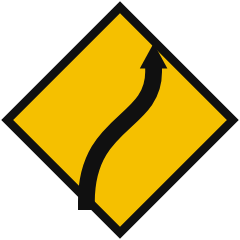
5. What does this sign tell a driver about the road ahead?
Show answer
Answer A: The roadway changes direction ahead, so speed should be reduced before reaching it
It gives advance notice of a change in alignment so the driver can slow down before entering, since braking inside a bend uses up grip that is needed for steering.
-
6. You receive a phone call that you feel you must answer while driving. What is the safest way to take it?
Show answer
Answer D: Pull off the road, stop in a safe place and then answer
No call is worth a crash. Stopping in a safe location removes the distraction completely, while every other option divides your attention.
-
7. How should you use your mirrors while another vehicle overtakes you on a multilane road?
Show answer
Answer C: Follow it from the inside mirror to the side mirror and then to your own view
Handing the vehicle from one mirror to the next keeps it in sight through the blind spot instead of losing it there.
-
8. A snow squall cuts visibility to almost nothing while you are on a highway. What must you not do?
Show answer
Answer D: Stop in a travel lane and wait for the squall to blow through
A vehicle stopped in a lane in a whiteout is invisible until someone hits it. Slow gradually and keep moving until you can leave the roadway completely.
-
9. A yellow diamond showing a truck is posted beside a quarry entrance. What is it warning about?
Show answer
Answer A: Trucks turning onto the highway from that entrance
A truck crossing or trucks entering sign is used where heavy vehicles pull onto the road from a site, and they accelerate slowly once they are on it.
-
10. You have a small extinguisher and a fire has started under the hood. What is the safe way to use it?
Show answer
Answer B: Release the latch and spray through the gap without raising the hood at all
Opening the hood feeds the fire a rush of air, so spraying through the gap at the base of the flames is both safer and more effective.
-
11. You are traveling at the same speed as a vehicle in the next lane, just behind its rear door. What should you do?
Show answer
Answer B: Change your speed so that you leave that driver's blind spot
That position is the classic blind spot. Slow slightly or move ahead so the other driver can see you before deciding to change lanes.
-
12. You are driving at night through heavy falling snow. Which headlight setting works better and why?
Show answer
Answer C: Low beams, because high beams bounce off the falling flakes back at you
Falling snow reflects light the way fog does, so high beams build a white wall of glare while low beams still give a usable view.
-
13. What is the main danger when you back out of an angle parking space?
Show answer
Answer A: Parked vehicles beside you hide the traffic coming along the aisle
You have to edge out blind past the vehicles on either side, so back very slowly and be ready to stop as soon as any part of the aisle comes into view.
-
14. What does Michigan provide for a driver who breaks the move over rule and injures a police officer at the scene?
Show answer
Answer B: A felony punishable by up to two years, a 1,000 dollar fine, or both
Causing injury to a police officer, firefighter or other emergency response personnel in the immediate area of the stationary emergency vehicle is a felony punishable by up to two years, a fine of not more than 1,000 dollars, or both.
-
15. You are entering a freeway using an on-ramp with an acceleration lane. What is the correct technique?
Show answer
Answer C: Use the acceleration lane to reach the speed of traffic, then merge into a gap while yielding to traffic already on the freeway
The acceleration lane exists so you can match the speed of freeway traffic before merging, and drivers already on the freeway have the right-of-way.
-
16. What follows a first Michigan work zone speeding offense recorded by an automated speed enforcement system?
Show answer
Answer C: A written warning
For a first automated work zone speeding violation, or one occurring more than three years after the last, the registered owner receives a written warning; a second within three years brings a fine of up to 150 dollars.
-
17. You are in the open lane where another lane is merging into yours. What is your part in the merge?
Show answer
Answer A: Keep a steady speed and leave a gap for one vehicle to come in
A merge works when each driver in the through lane lets one vehicle in, which keeps both lines moving instead of stopping them both.
-
18. You are parked legally, but a police officer tells you to move the vehicle. What should you do?
Show answer
Answer B: Move it as directed, because an officer overrides the signs
Directions from a police officer or a firefighter take precedence over signs and markings, whether they are directing traffic or clearing a street.
-
19. Your vehicle leaves the road and enters deep water. What gives you the best chance of escape?
Show answer
Answer B: Release your seat belt and get out through a window as quickly as possible
Water pressure holds the doors shut, so a window is the reliable exit and the first seconds after entry are the best time to use it.
-
20. The rear of your vehicle begins to slide sideways on a slippery surface. What is the correct correction?
Show answer
Answer C: Ease off the accelerator and steer in the direction you want the front of the vehicle to go
Looking and steering toward your intended path lines the front wheels up with the direction of travel, while sudden braking or a sharp opposite input usually makes the slide worse.
-
21. You have driven at 70 mph for an hour and then exit onto a town street. What is the common risk?
Show answer
Answer B: Your sense of speed adapts, so 35 mph feels slow and you drive too fast
After a long stretch at high speed the brain adapts, so town speeds feel unnaturally slow; check the speedometer instead of trusting the feeling.
-
22. You want to reverse direction but the street is too narrow for a U-turn. What is the alternative?
Show answer
Answer D: Make a three-point turn, or go around the block in heavy traffic
Where there is not enough width for a U-turn, the three-point turn does the job in stages, and on a busy street going around the block is safer still.
-
23. You are waiting to enter a two-lane roundabout and traffic is circulating in both lanes. What must you do?
Show answer
Answer A: Yield to traffic in both circulating lanes before you enter
Every entry to a roundabout is a yield point, and at a two-lane roundabout that means giving way to vehicles in either circulating lane.
-
24. You have turned onto a street and see parked cars facing you and headlights coming toward you. What has probably happened?
Show answer
Answer C: You have turned the wrong way onto a one-way street
Vehicles parked facing you and headlights approaching in your lane are the classic signs of driving against the flow on a one-way street.
-
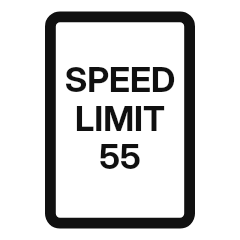
25. On a clear day with light traffic, a driver stays far below the maximum this sign sets. What can that cause?
Show answer
Answer B: Obstruction of the normal flow of traffic, which is prohibited in itself
Driving so slowly that other traffic is impeded is an offense in its own right when nothing about safety, weather or the road calls for it.
-
26. Is it safe to check your phone while stopped at a red light?
Show answer
Answer B: No, you may miss the signal change and hazards around you
Attention does not return instantly when the light changes, and emergency vehicles, pedestrians or a rear-end threat can appear while you are stopped. Stay focused on the road.
-
27. Well before an intersection, an overhead sign shows a diagram of the lanes with an arrow above each one. What is its purpose?
Show answer
Answer C: To let drivers pick the correct lane in good time
Advance intersection lane control signs display the lane assignment far enough back that drivers can move over calmly instead of at the last moment.
-
28. Why should a driver crossing several lanes change only one lane at a time?
Show answer
Answer B: Each lane has its own traffic and its own blind spot to be checked
Sweeping across two or three lanes means entering lanes you never checked, so each change gets its own signal, mirror check and head check.
-
29. How should tire pressure be checked and set?
Show answer
Answer B: When the tires are cold, set to the pressure specified by the vehicle manufacturer
Driving heats the air and raises the reading, and the sidewall number is a maximum rather than a recommendation, so check cold and use the figure on the vehicle placard or in the owner's manual.
-
30. The electric windows will not work as your vehicle sinks in water. What is the best option?
Show answer
Answer C: Break a side window with a hard, pointed object and climb out through it
Side windows are tempered glass and can be broken, while the laminated windshield cannot, and water pressure holds the doors shut.
-
31. As speed rises, which part of the total stopping distance grows the fastest?
Show answer
Answer B: The braking distance, which grows far faster than speed itself
Perception and reaction distances grow in step with speed, but braking distance grows roughly with the square of speed, so it dominates at higher speeds.
-
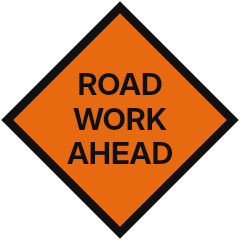
32. How should speed and following distance be adjusted beyond this sign?
Show answer
Answer D: Cut speed and leave a longer gap, because traffic can stop without warning
Traffic in these areas stops and starts unexpectedly and there is little room to steer around a problem, so extra space is what prevents a rear-end collision.
-
33. At what tread depth should a tire be replaced?
Show answer
Answer A: When the tread is worn down to 2/32 of an inch
At that depth a tire loses grip quickly, especially on wet roads, and the built in wear bars or the penny test both show when the point has been reached.
-
34. May you stop briefly across the sloped ramp that joins the sidewalk to the street at a corner?
Show answer
Answer B: No, that ramp must stay clear for people using wheelchairs
A curb ramp is the only way many people can get from the sidewalk to the crosswalk, so blocking it even briefly is prohibited.
-
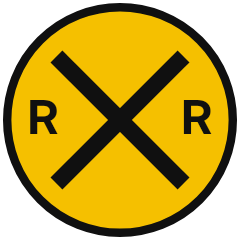
35. A driver sees this sign on a quiet road with no other traffic in either direction. What is the correct response?
Show answer
Answer C: Slow down, look and listen for a train, and be ready to stop
The sign gives advance notice of a highway-rail grade crossing, so the driver reduces speed, checks both directions along the tracks and keeps enough room to stop short of the rails.
-
36. How do stimulant drugs such as amphetamines or cocaine typically affect driving?
Show answer
Answer D: They can make the driver overconfident and more willing to take risks
Stimulants create a false sense of alertness and encourage aggressive, risky driving. When they wear off, sudden fatigue can follow.
-
37. You are backing straight down a driveway while looking over your right shoulder. Where should your left hand be?
Show answer
Answer C: At the top of the steering wheel, holding it with a firm grip
With one hand at the top of the wheel you can hold a straight course and make small corrections while your body is turned to look behind.
-
38. Rain is falling and the outside temperature reads close to 32 degrees Fahrenheit. Why is that dangerous?
Show answer
Answer A: The rain can freeze on contact and glaze the road with ice
Near freezing, rain landing on cold pavement can turn to a glaze of ice almost at once, so a road that looks merely wet may have no grip at all.
-
39. In which crash must the police always be notified?
Show answer
Answer D: Any crash in which somebody has been injured or killed, whatever the damage
Injury or death always makes a crash reportable, whatever the amount of vehicle damage or the opinions of the drivers.
-
40. You have turned onto a ramp at night and your headlights pick out large white arrows painted on the pavement pointing straight back at you. What do they mean?
Show answer
Answer C: You are traveling against the flow and must turn back
Wrong-way arrows are laid so that a driver going the correct way never sees them head on, so an arrow pointing at you means you are on the ramp backwards.
-
41. When should you adjust your seat, mirrors and steering wheel?
Show answer
Answer B: Before you start moving
Adjusting the driving position while moving takes your attention and often your hands away from driving. Make every adjustment while parked, every time.
-
42. What does the solid white line running along the right side of a highway mark?
Show answer
Answer A: The right edge of the traveled way
A solid white edge line shows where the traveled way ends on the right, which is particularly useful at night and in poor visibility.
-
43. How long does a Michigan driver have to request a hearing after refusing a chemical test?
Show answer
Answer A: 14 days from the date of the notice
The officer must notify the driver in writing that a hearing may be requested within 14 days of the date of the notice, and failure to request one brings the suspension automatically.
-
44. A barricade carries a sign reading ROAD CLOSED TO THROUGH TRAFFIC. What does it permit?
Show answer
Answer B: Local access for people whose destination is on that road
This closure keeps out drivers who are only passing through while still allowing residents and deliveries to reach addresses within the closed section.
-
45. Traffic ahead of you has stopped in your lane while the next lane is still moving. What is the first thing to do?
Show answer
Answer C: Slow down first and check the next lane before moving over
Braking is the action that keeps you from hitting the stopped traffic, and the lane change is only safe once you have looked.
-
46. A driver who is passing you cannot complete the pass because a vehicle is coming. What should you do?
Show answer
Answer C: Ease off the accelerator and make room for them to drop back in
The only place for the passing vehicle to go is the gap behind you, and easing off opens that gap immediately.
-
47. A driver on a hands free call looks straight at a red light and drives through it. What best explains this?
Show answer
Answer B: The eyes saw it but the brain did not process it
Attention, not eyesight, decides what a driver actually sees, and a loaded mind can leave a driver looking straight at a hazard without registering it.
-
48. In a vehicle with automatic transmission, which foot should operate the brake and accelerator?
Show answer
Answer D: The right foot for both pedals
Using only the right foot prevents pressing both pedals at once and keeps the response the same in every vehicle you drive. The left foot rests on the floor or the footrest.
-
49. You are involved in a collision, even a minor one. What is your first legal duty?
Show answer
Answer A: Stop at or near the scene without blocking traffic more than necessary
Every driver involved in a crash must stop at the scene, and leaving before meeting that duty is a serious offense. Move the vehicles only as far as needed to clear the traffic lanes.
-
50. Why is this restriction so common beside fire hydrants, crosswalks and intersection corners?
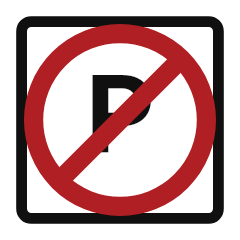
Show answer
Answer C: To keep sight lines open and leave access for emergency crews
A vehicle left in those places hides pedestrians from approaching drivers, blocks the path of turning vehicles and can keep firefighters from reaching a hydrant.