
Michigan SOS Motorcycle Practice Test 24
- Questions20
- Correct to pass16
- Passing score80%
- Minimum age16 years
-
1. An emergency vehicle with flashing lights and a siren is approaching from behind on a two-way street. What should you do?
Show answer
Answer C: Pull over to the right edge of the road and stop until it passes
Clearing a path by pulling to the right and stopping gives the emergency vehicle a predictable route, while stopping in mid-lane or inside an intersection blocks that path.
-
2. What should be adjusted on the motorcycle before carrying a passenger?
Show answer
Answer C: The suspension and the tire pressure, following the owner's manual
The extra weight compresses the suspension and loads the tires, so both should be set to the values the manufacturer specifies for riding with a passenger.
-
3. You are driving on a rural road with no sidewalk. Where should you expect to meet pedestrians?
Show answer
Answer A: Walking toward you on your side of the road
Where there is no sidewalk, pedestrians are taught to walk facing traffic, so they appear on your side of the road coming toward you.
-
4. You are in the open lane where another lane is merging into yours. What is your part in the merge?
Show answer
Answer A: Keep a steady speed and leave a gap for one vehicle to come in
A merge works when each driver in the through lane lets one vehicle in, which keeps both lines moving instead of stopping them both.
-
5. It is hot and a rider wants to ride without gloves. Why is that a poor idea?
Show answer
Answer D: Sweating hands slip on the grips, and bare skin has no protection
Hands go out first in a fall and are hard to repair, and sweaty palms lose their grip on the controls, so wear ventilated summer gloves rather than none.
-
6. What should a rider do before riding an unfamiliar or borrowed motorcycle?
Show answer
Answer B: Locate and try the controls, then ride cautiously until used to the machine
Turn signals, horn, headlight switch, fuel valve and engine cut-off switch sit in different places on different models, and hunting for them in traffic is dangerous.
-
7. Two solid white lines separate your lane from the lane beside it. What do they mean?
Show answer
Answer B: Crossing from one lane to the other is prohibited
A solid double white line marks a boundary that road users may not cross, such as the entrance to a preferential lane.
-
8. You reach a four-way stop after another driver has already stopped there. What should you do?
Show answer
Answer D: Let the driver who stopped first proceed before you go
At a four-way stop the vehicles proceed in the order they arrived, so a driver who stopped before you goes first.
-
9. Two drivers each have three drinks, one over three hours and one in half an hour. What is the difference?
Show answer
Answer C: The fast drinker reaches a higher peak level
The liver removes alcohol at a steady rate, so drinking faster than the body can clear it pushes the blood alcohol level much higher.
-
10. In a staggered group, where does the leader normally ride?
Show answer
Answer B: In the left portion of the lane
The leader takes the left portion of the lane, which gives a wide view of the road ahead and sets up the staggered pattern for everyone behind.
-
11. How should you handle a prescription or over the counter medicine before driving?
Show answer
Answer D: Read the label and ask a pharmacist or doctor whether it affects driving
Many common medicines, including allergy and cold remedies, cause drowsiness or slowed reactions, and the label or a pharmacist can tell you whether driving is safe.
-
12. A rectangular red sign with the white words WRONG WAY means that
Show answer
Answer C: the driver is already traveling against the legal flow and must not continue
The wrong way sign uses a white legend and border on red and addresses a driver who has entered a ramp or one-way roadway in the wrong direction, who should stop and turn around safely.
-
13. A loaded truck is coming up an entrance ramp as you approach in the right lane of the freeway. What is the most helpful action?
Show answer
Answer A: Adjust your speed to open a gap for it
A heavy vehicle accelerates slowly, so opening a gap or moving over costs you seconds and saves the truck driver from being forced to stop on the ramp.
-
14. What does a marked crosswalk tell a driver approaching a corner?
Show answer
Answer D: Where pedestrians are expected to cross and must be given way
Crosswalk markings show pedestrians where to cross and warn drivers to yield to anyone using the crossing.
-
15. On a wet road, how should a driver adjust after passing this sign?
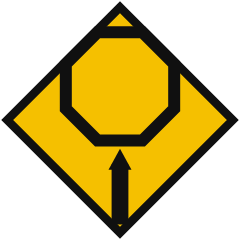
Show answer
Answer B: Start braking earlier, because a slippery surface lengthens the stopping distance
A wet surface lengthens stopping distance, so the extra warning distance should be spent braking gently and early instead of late and hard.
-
16. What is the correct way to secure a load on a motorcycle?
Show answer
Answer C: Fasten it with elastic cords using several attachment points and check it at every stop
Several attachment points hold the load tight so it cannot shift or fall into the wheel or the chain, and checking at stops catches a load that has worked loose.
-
17. As speed rises, which part of the total stopping distance grows the fastest?
Show answer
Answer B: The braking distance, which grows far faster than speed itself
Perception and reaction distances grow in step with speed, but braking distance grows roughly with the square of speed, so it dominates at higher speeds.
-
18. A sign on a long descent points to a RUNAWAY TRUCK RAMP a mile ahead. What is that ramp for?
Show answer
Answer C: Stopping a vehicle whose brakes have failed
An escape ramp climbs into deep gravel or sand to bring a vehicle with failed brakes to a halt, so no one should stop or park in it.
-
19. A car is passing you on a two lane road. Which lane position is generally best while it goes by?
Show answer
Answer A: The center portion of your lane
The middle of the lane keeps distance from the passing vehicle and its mirrors while leaving room on the other side if the rider needs it.
-
20. How long should a head check before a lane change last?
Show answer
Answer D: A quick glance, so you do not lose track of what is happening ahead
Traffic ahead can change in a second, so the blind spot check is a fast glance and the rider returns attention to the road immediately.