
Michigan SOS Motorcycle Practice Test 44
- Questions20
- Correct to pass16
- Passing score80%
- Minimum age16 years
-
1. How does eating a large meal before drinking affect impairment?
Show answer
Answer D: It slows absorption but the alcohol still reaches the blood and impairs you
Food delays how quickly alcohol enters the bloodstream, which can make the peak arrive later, but all of the alcohol is eventually absorbed.
-
2. How should a passenger behave through a turn?
Show answer
Answer B: Look over the operator's shoulder in the direction of the turn and avoid sudden movement
Looking over the operator's shoulder into the turn keeps the passenger aligned with the motorcycle, and avoiding sudden movement prevents unexpected changes in balance.
-
3. Why is passing another vehicle a bad idea in dense fog?
Show answer
Answer C: You cannot see far enough ahead to know the passing lane is clear
A pass needs a clear view of the road well beyond the vehicle you are overtaking, and fog takes exactly that away.
-
4. What happens if a passenger leans the opposite way to the rider in a curve?
Show answer
Answer B: The motorcycle becomes harder to steer and may run wide in the curve
A passenger leaning against the turn fights the lean angle the rider has set, forcing extra steering effort and pushing the machine toward the outside of the curve.
-
5. On a two-lane road, a solid yellow line runs on your side of the center while a broken yellow line runs on the other side. What does this mean?
Show answer
Answer D: You may not pass, although oncoming drivers may
Passing restrictions are read from the line closest to your own lane, so a solid yellow line on your side creates a no-passing zone for you alone.
-
6. You are waiting to pull out of a driveway when a bicyclist comes along the bike lane in front of you. What must you do?
Show answer
Answer D: Wait until the bicyclist has gone past
A driver leaving a driveway yields to everything already on the road, and a bike lane is part of the roadway.
-
7. You are in the acceleration lane and the gap you were aiming for is now beside you. What is the best adjustment?
Show answer
Answer A: Change your speed a little to line up with a gap, then merge smoothly
The acceleration lane is for matching both the speed and the position of a gap, and small speed adjustments are what line the two up.
-
8. When should a helmet be replaced?
Show answer
Answer B: After a crash, or if the shell is cracked or the straps are frayed
The energy absorbing liner is designed to crush once, so a helmet that has taken an impact or shows damage no longer offers full protection.
-
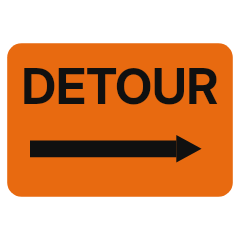
9. Once a driver has joined the route this sign begins, how is the rest of the way marked?
Show answer
Answer B: By further markers of the same kind at each turn, until the original road is rejoined
The alternate route is signed continuously, with a marker at every turn, so a driver with no local knowledge can follow it back to the original road.
-
10. A driver ahead of you extends the left arm straight out horizontally through the window. What is being signaled?
Show answer
Answer C: A left turn
The left arm held straight out is the standard hand signal for a left turn.
-
11. A driver reaching a stop sign is required to do what?
Show answer
Answer D: Come to a complete stop and then proceed only when it is safe
A stop sign requires a full stop before the stop line, crosswalk or intersection, after which the driver may go on once the way is clear.
-
12. On a regulatory sign, what does a red circle with a diagonal slash drawn over a symbol mean?
Show answer
Answer D: The movement or action shown by the symbol is prohibited
A red circle with a diagonal slash is the standard way of showing that the movement pictured inside it, such as a U-turn or a right turn, is not allowed.
-
13. What is a designated driver?
Show answer
Answer A: Someone who agrees to drink nothing at all
A designated driver drinks no alcohol whatsoever, because any amount begins to affect judgment and the whole point is a sober driver.
-
14. What does the implied consent law mean for drivers?
Show answer
Answer D: By driving, you have agreed to a chemical test if lawfully arrested for impaired driving
Holding a license and driving on public roads is treated as consent to breath, blood or urine testing when an officer has grounds to arrest you. Refusing normally brings its own license penalties.
-
15. A white diamond symbol is painted in a highway lane. What does it identify?
Show answer
Answer C: A lane reserved for high-occupancy vehicles
The diamond symbol marks a preferential lane, most often one reserved for vehicles carrying a minimum number of occupants.
-
16. What should the operator do while a passenger climbs on board?
Show answer
Answer D: Sit on the machine with both feet planted and the front brake held on
The added weight arrives suddenly and off center, so the operator braces the motorcycle with both feet down and the front brake applied to keep it still.
-
17. A tow truck with flashing amber lights is loading a car on the shoulder ahead. How should you treat it?
Show answer
Answer B: Give it the same room as an emergency vehicle
Tow operators, utility crews and highway workers face the same danger from passing traffic, so move over or slow down for their flashing amber lights too.
-
18. Partway through a ride, a control starts to feel different from the way it normally feels. What is the right response?
Show answer
Answer B: Stop somewhere safe and find out what has changed before riding further
A change in feel is usually the first warning of a failing cable, a leaking brake or a loose fastener, and it is far cheaper to check at the roadside than to discover in traffic.
-
19. You have turned onto a street and see parked cars facing you and headlights coming toward you. What has probably happened?
Show answer
Answer C: You have turned the wrong way onto a one-way street
Vehicles parked facing you and headlights approaching in your lane are the classic signs of driving against the flow on a one-way street.
-
20. A center lane is bordered by a solid yellow line on the outside and a broken yellow line on the inside, with left-turn arrows painted in it. How may you use that lane?
Show answer
Answer A: Only to make a left turn or to prepare for one from either direction
That marking identifies a two-way left turn lane, which may only be used for left turns or to prepare for a left turn and never for travel or passing.