
Michigan SOS Motorcycle Practice Test 64
- Questions20
- Correct to pass16
- Passing score80%
- Minimum age16 years
-
1. You have had to leave the pavement onto a loose gravel shoulder and now need to stop. How should you brake?
Show answer
Answer D: Use both brakes gently and evenly, expecting a much longer stopping distance
Loose gravel cuts available traction sharply, so apply both brakes lightly and smoothly and allow far more room than you would need on pavement.
-
2. May you park at the curb immediately next to a railroad crossing?
Show answer
Answer A: No, you must leave the crossing and its approach clear
Parking beside a crossing hides the tracks and the signals from approaching drivers and leaves no room for a vehicle that has to clear the rails.
-
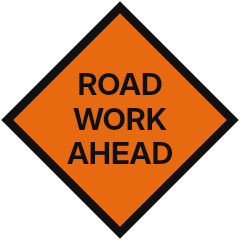
3. Beyond this sign, cones and temporary signs lead traffic along a path that does not agree with the lines painted on the pavement. Which one must the driver follow?
Show answer
Answer C: The temporary arrangement, because it replaces the permanent layout while the work lasts
Temporary traffic control set up for the work takes precedence over the permanent signs and markings, which no longer describe how the road is being used.
-
4. What must a Michigan court do when a driver cited for defective safety equipment repairs it before the appearance date?
Show answer
Answer D: Waive the civil fine, costs and assessments on police certification
Where a law enforcement agency certifies that the defective equipment was repaired before the appearance date, the court must waive the civil fine, the costs and the assessments.
-
5. The road ahead is broken up with potholes and rough patches. What should you do?
Show answer
Answer C: Slow down, since a hole hit at speed can wreck a tire or wheel
A lower speed cuts the impact on tires, wheels and suspension and gives you time to choose a line through the rough surface.
-
6. At a four-way stop another driver pulls out ahead of you when it was clearly your turn. What is the correct response?
Show answer
Answer B: Let that driver go through, then take your turn when the way is clear again
Right of way is something you give, never something you take, so yielding to a driver who takes it wrongly avoids a crash you would otherwise share.
-
7. On an undivided two-lane road you meet a school bus coming toward you with its red lights flashing and its stop arm out. What must you do?
Show answer
Answer C: Stop and wait until the red lights stop flashing
On an undivided road drivers in both directions must stop for a school bus loading or unloading, because children may cross in front of it.
-
8. Along a highway the reference markers count upward as you travel. Where does the numbering normally begin?
Show answer
Answer C: At the southern or western edge of the state
Mileage numbering starts where the route enters the state from the south or the west, so rising numbers tell a driver which way they are heading.
-
9. Where should the least experienced riders be placed in a group?
Show answer
Answer C: Just behind the leader
Placing newer riders just behind the leader keeps the pace manageable for them and lets the more experienced riders behind keep an eye on them.
-
10. How should a rider dress for a long ride in very hot weather?
Show answer
Answer C: In ventilated riding gear that still covers the arms and legs
Mesh and vented riding gear flows air while keeping its abrasion protection and shading the skin, so heat is not a reason to ride uncovered.
-
11. You have turned onto a ramp at night and your headlights pick out large white arrows painted on the pavement pointing straight back at you. What do they mean?
Show answer
Answer C: You are traveling against the flow and must turn back
Wrong-way arrows are laid so that a driver going the correct way never sees them head on, so an arrow pointing at you means you are on the ramp backwards.
-
12. Yellow signs each showing one large black arrowhead, installed in a row along the outside of a curve, are
Show answer
Answer D: chevron alignment signs marking the change of direction of the curve
Chevron alignment signs are placed on the outside of a curve so that several are in view at once, letting the driver judge how sharply the road turns.
-
13. Why should you avoid parking over tall dry grass or a pile of dead leaves?
Show answer
Answer B: Because the hot exhaust can set the dry material on fire
The exhaust system stays hot for a long time after a drive and can ignite dry vegetation underneath the vehicle.
-
14. A yellow diamond showing a bicycle is posted on a rural road. What should a driver expect?
Show answer
Answer A: Bicyclists crossing or riding along the roadway there
The bicycle warning sign is used where a bikeway crosses the road or where riders are likely to be in the traffic lanes, so drivers should look carefully and pass wide.
-
15. Your vehicle breaks down on a busy highway. What is the safest course of action?
Show answer
Answer D: Get it as far off the roadway as possible, switch on the hazard lights and keep clear of the traffic lanes
A vehicle left in or beside a travel lane is a hazard, so move it well off the road, make it conspicuous with hazard lights and keep yourself away from passing traffic.
-
16. How does a rider judge whether the brake pads still have life left in them?
Show answer
Answer A: By looking at how much friction material is left on the pad
Pads are inspected visually for remaining thickness against the wear indicator, because a pad worn to its backing plate will destroy the disc.
-
17. You are ready to pull out of a parallel parking space into the traffic lane. What should you do?
Show answer
Answer C: Signal, check the mirror and blind spot, and wait for a gap
A driver leaving a parking space must yield to traffic already in the lane, so signal, look for the gap and only then move out.
-
18. You are approaching an uncontrolled intersection on a residential street where parked cars hide the cross street. What is the correct approach?
Show answer
Answer B: Slow enough to stop and creep out until you can see
Without a sign or signal you still have to be able to yield, and you cannot yield to traffic you have not seen.
-
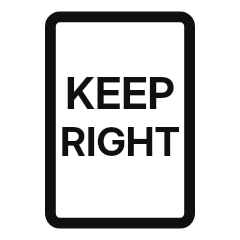
19. Where is this sign normally installed?
Show answer
Answer A: At an island or other obstruction in the roadway, to show which side traffic must take
It is placed at a divider, island or fixed obstruction so that drivers approaching it know without hesitating which side to pass on.
-
20. You have a green light and are turning right while people are crossing the street you want to enter. Who goes first?
Show answer
Answer B: The pedestrians, and you wait until they are clear of your path
A green light permits the turn but does not remove the duty to yield to pedestrians already crossing the street you are turning into.