
Michigan SOS Motorcycle Practice Test 11
- Questions20
- Correct to pass16
- Passing score80%
- Minimum age16 years
-
1. What is the danger of releasing the brake too early when moving off uphill?
Show answer
Answer C: The motorcycle rolls backward before the clutch has taken hold
On a grade the brake has to stay on until the engine is actually pulling, otherwise the machine runs back into whatever is behind it.
-
2. What do yellow lines painted on a roadway separate?
Show answer
Answer D: Traffic moving in opposite directions
Yellow markings separate opposing streams of traffic, and they also mark the left edge of a divided highway or a one-way roadway.
-
3. What is the job of the hard outer shell of a motorcycle helmet?
Show answer
Answer D: To spread impact force and to resist objects punching through
The shell distributes a concentrated blow over a wide area and stops sharp objects from reaching the head, while the liner underneath absorbs the energy.
-
4. How much community service may a Michigan court order for a first operating while intoxicated conviction?
Show answer
Answer C: Up to 360 hours
A first operating while intoxicated conviction may carry community service of not more than 360 hours, either instead of or alongside jail and a fine.
-
5. Which combination best reduces the chance of hydroplaning?
Show answer
Answer D: Good tread depth, correct tire pressure and lower speed in the rain
Tread channels water away, correct pressure keeps the tire's shape, and lower speed gives the tire time to push water aside. Hydroplaning can begin at surprisingly modest speeds.
-
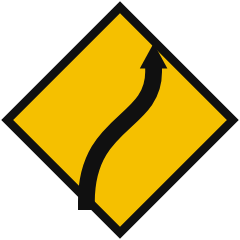
6. A driver holds a steady highway speed into the section this sign warns about. What is the most likely result?
Show answer
Answer B: The vehicle runs wide toward the outside and can cross into another lane or leave the pavement
Holding speed into a change of alignment asks the tires for more side grip than they can supply, so the vehicle runs wide and the driver is left with less room to correct.
-
7. A pedestrian using a white cane or walking with a guide dog starts to cross the street ahead of you. What must you do?
Show answer
Answer A: Yield and stay stopped until the person has finished crossing
A white cane or guide dog identifies a pedestrian who may not be able to see your vehicle, so you must yield and wait rather than maneuver around the person. The horn can confuse the pedestrian or the dog.
-
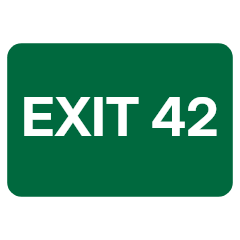
8. A driver in the left lane of a freeway realizes only when level with this sign that the ramp beside it is the one they need. What is the correct action?
Show answer
Answer A: Carry on to the next interchange and turn back from there
There is no safe way back to a ramp once it has been reached from the wrong lane, so the driver keeps going to the next interchange, where the ramps are built for that movement.
-
9. How do worn tires and worn brakes affect your ability to stop?
Show answer
Answer C: They lengthen the stopping distance, especially on a wet road
Worn tread cannot clear water and worn brakes cannot produce full force, so both stretch the distance needed to stop.
-
10. A stop sign at a busy corner has a stop line and a crosswalk, but buildings block your view of the cross street. What is the correct sequence?
Show answer
Answer C: Stop at the line first, then edge forward and stop again to see
The first stop is required at the line or before the crosswalk, and a second stop farther forward is what actually lets you yield safely.
-
11. Which surfaces usually offer less grip than the pavement around them when wet?
Show answer
Answer B: Painted markings, metal plates and bridge decks
Paint, steel and bridge decks all shed grip when wet or cold, so brake before you reach them rather than on top of them.
-
12. On a street with parking along the curb, the shared lane marking is painted well out from the curb face. What does that placement tell a bicyclist?
Show answer
Answer C: To ride clear of the doors of parked cars
The marking is set at least eleven feet from the curb where parking is allowed so that riders are guided outside the reach of an opening door.
-
13. On an overhead guide sign, the small exit number panel sits above the left-hand end rather than the right. What does that placement tell you?
Show answer
Answer A: The exit leaves from the left side of the roadway
The exit number plaque is placed on the side from which the ramp leaves, which gives advance notice of the unusual left-hand exit.
-
14. You receive a phone call that you feel you must answer while driving. What is the safest way to take it?
Show answer
Answer D: Pull off the road, stop in a safe place and then answer
No call is worth a crash. Stopping in a safe location removes the distraction completely, while every other option divides your attention.
-
15. You are approaching an intersection in a line of traffic. What can you do to be more visible to a driver waiting to pull out?
Show answer
Answer D: Move to a lane position where you are not hidden behind the vehicle ahead
A motorcycle tucked directly behind a larger vehicle is invisible to a waiting driver until the moment it appears, so the rider moves to where the headlight can be seen.
-
16. You are riding up an entrance ramp to merge onto a freeway. What should you do?
Show answer
Answer D: Build up to traffic speed on the ramp, then signal and check the blind spot
Matching the speed of freeway traffic before merging avoids forcing others to brake, and a head check covers the area the mirrors do not show.
-
17. When are the hazard warning lights properly used?
Show answer
Answer A: When your vehicle is stopped or barely moving and is a hazard
Hazard lights warn that your vehicle is an obstruction; they do not authorize illegal parking and they hide your turn signals while driving.
-
18. A pedestrian signal displays a steady walking person symbol. What does it mean for a pedestrian at that corner?
Show answer
Answer B: The pedestrian may start crossing in the direction of the signal
The steady walking person permits a pedestrian to begin the crossing, while still yielding to vehicles already lawfully in the intersection.
-
19. Alcohol is classified as which kind of drug?
Show answer
Answer B: A depressant that slows the central nervous system
As a depressant, alcohol slows the brain and nervous system, which lengthens reaction time and dulls the coordination that driving depends on.
-
20. Your loaded vehicle weighs more than the figure shown on a posted weight limit sign. What must you do?
Show answer
Answer D: Find another route, because crossing is not permitted
A posted weight limit is a legal maximum, not advice, so an overweight vehicle has to take a different route.