
Michigan SOS Motorcycle Practice Test 2
Test 2 of 6. Pick an answer for each question to see if it is right and why; your score appears at the end. You need 16 correct answers to pass, the same ratio as the real Michigan test.

- Questions20
- Correct to pass16
- Passing score80%
- Minimum age16 years
-
1. What does Michigan provide for a driver who breaks the move over rule and injures a police officer at the scene?
Show answer
Answer B: A felony punishable by up to two years, a 1,000 dollar fine, or both
Causing injury to a police officer, firefighter or other emergency response personnel in the immediate area of the stationary emergency vehicle is a felony punishable by up to two years, a fine of not more than 1,000 dollars, or both.
-
2. What is Michigan's general speed limit on trunk line and county highways where no other limit is fixed?
Show answer
Answer C: 55 mph
The Michigan Vehicle Code fixes 55 miles per hour as the general speed limit on all trunk line and county highways where a limit is not otherwise set.
-
3. Where no other limit is fixed, what is the maximum speed on a Michigan limited access freeway?
Show answer
Answer D: 70 mph
The limited access freeway general speed limit is 70 miles per hour where no other limit has been fixed, though certain freeway sections are signed higher after an engineering study.
-
4. What makes a left turn protected rather than permissive?
Show answer
Answer B: Oncoming traffic is held by a red signal while you have a green arrow
A protected turn is one where the conflicting movements are stopped by their own signal, which is what the green arrow indicates.
-
5. What happens to the civil fines in Michigan when a crash occurs and the at-fault driver was manually using a mobile device?
Show answer
Answer B: They are doubled
Michigan doubles any civil fines when a traffic crash occurs and the at-fault driver was holding or manually using a mobile electronic device.
-
6. What follows a first Michigan work zone speeding offense recorded by an automated speed enforcement system?
Show answer
Answer C: A written warning
For a first automated work zone speeding violation, or one occurring more than three years after the last, the registered owner receives a written warning; a second within three years brings a fine of up to 150 dollars.
-
7. A motorcycle ahead of you is weaving slightly as it crosses a stretch of grooved pavement. What should you do?
Show answer
Answer D: Give the rider extra room until the surface improves
Grooves, metal plates and loose material affect a motorcycle far more than a car, so back off and let the rider deal with the surface.
-
8. What must a Michigan rider under 18 do to obtain a motorcycle endorsement?
Show answer
Answer C: Successfully complete a motorcycle safety course
Riders under 18 in Michigan must successfully complete an approved motorcycle safety course before the endorsement can be added.
-
9. What does the Michigan hands-free law prohibit while operating a vehicle?
Show answer
Answer A: Holding or supporting a device with any part of the hands, arms or shoulders
Michigan drivers may not hold or support a phone or other mobile device with their hands, arms or shoulders, and a mounted device may only receive a single touch.
-
10. How far below the normal posted limit may a Michigan school zone speed limit be set?
Show answer
Answer B: By up to 20 mph, but never below 25 mph
A Michigan school zone limit may be decreased by not more than 20 miles per hour below the normally posted limit and may not be set lower than 25 miles per hour.
-
11. How long does a Michigan driver have to request a hearing after refusing a chemical test?
Show answer
Answer A: 14 days from the date of the notice
The officer must notify the driver in writing that a hearing may be requested within 14 days of the date of the notice, and failure to request one brings the suspension automatically.
-
12. A driver slows to walking pace at this sign, never stops rolling and eases into the intersection. How is that treated?

Show answer
Answer B: It is a violation, because the vehicle never came to a complete halt
What is required is a full halt with the wheels no longer turning, so slowing down, however carefully, does not satisfy it.
-
13. May a Michigan driver overtake a bicycle inside a marked no-passing zone?
Show answer
Answer A: Yes, if it is safe to do so
Michigan expressly allows a driver to overtake and pass a bicycle in a no-passing zone when it is safe to do so.
-
14. A bicyclist is riding around a single-lane roundabout in the middle of the lane as you wait to enter. What is your duty?
Show answer
Answer C: Yield to the bicyclist just as you would to a car
A bicyclist using the roundabout is traffic like any other vehicle and has the same claim to the circulating lane.
-
15. To make a motorcycle lean into a turn at normal riding speed, the rider should:
Show answer
Answer C: Press forward on the handgrip on the side of the turn
This is countersteering: press left to lean left and go left, press right to lean right and go right.
-
16. What does Michigan law define as any bodily alcohol content for a driver under 21?
Show answer
Answer B: 0.02 or more but less than 0.08
For drivers under 21, any bodily alcohol content means 0.02 grams or more but less than 0.08, or any presence of alcohol from drinking outside a recognized religious service.
-
17. On a two-way street, where and how should you park at the curb?
Show answer
Answer C: On the right side, facing the way traffic moves
On a two-way street you must park on the right, headed in the direction of travel; parking facing traffic is prohibited.
-
18. Apart from completing an approved safety course, how may a Michigan rider earn the CY endorsement?
Show answer
Answer A: Pass the vision and knowledge tests, take a permit, then pass the Rider Skills Test
A rider who does not take the safety course route must pass the vision and knowledge tests, hold a Temporary Instruction Permit and then pass the Rider Skills Test at an approved driver testing business.
-
19. How should a driver respond to this sign?
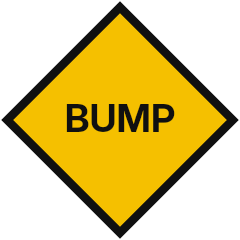
Show answer
Answer C: Slow down before reaching the rough spot and cross it at a steady, low speed
Losing speed before a sharp rise in the pavement keeps the vehicle settled, while braking or accelerating on top of it unsettles the suspension and costs grip.
-
20. When should a rider use both brakes together?
Show answer
Answer D: Every time the motorcycle slows or stops
Using both brakes for every stop shortens stopping distance and builds the habit the rider will fall back on when a sudden stop is needed.