
Michigan SOS Motorcycle Practice Test 61
- Questions20
- Correct to pass16
- Passing score80%
- Minimum age16 years
-
1. A driver waiting to turn left appears to be looking straight at you. What should you assume?
Show answer
Answer C: That the driver may still not have seen you, and may turn across your path
Drivers look toward motorcycles without registering them, so eye contact is not evidence that the rider has been seen and no plan should depend on it.
-
2. You want to move into the right lane just as an entrance ramp joins the highway at that point. What is the better choice?
Show answer
Answer B: Wait until you are past the merge area so you do not squeeze the entering traffic
The merge area is where ramp traffic has to find a gap, so adding a lane change of your own into the same space creates a conflict.
-
3. A motorcycle in your group develops a mechanical problem on a busy highway. What is the best response?
Show answer
Answer C: Signal the group off at the next exit or wide, safe pull off area
A narrow shoulder beside fast traffic is a dangerous place to gather, so the group moves on to a spot where every machine is well clear of the roadway.
-
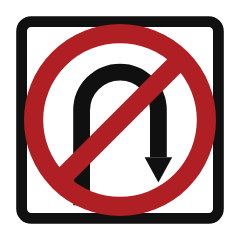
4. A driver who wants to reverse direction arrives at this sign. What is allowed?
Show answer
Answer C: Going on and reversing direction only where the maneuver is permitted
The restriction removes that maneuver at that spot entirely, so the driver has to continue and turn the vehicle around at a place where it is not prohibited.
-
5. When should a staggered group change to single file?
Show answer
Answer C: In curves, in turns, and when entering or leaving a highway
Curves, turns and highway entrances and exits require the full width of the lane, so the group rides single file at those points.
-
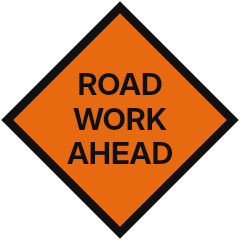
6. How should speed and following distance be adjusted beyond this sign?
Show answer
Answer D: Cut speed and leave a longer gap, because traffic can stop without warning
Traffic in these areas stops and starts unexpectedly and there is little room to steer around a problem, so extra space is what prevents a rear-end collision.
-
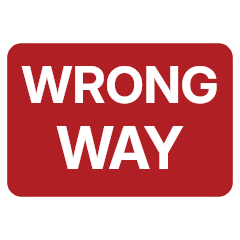
7. This sign comes into view ahead of a driver who has already started along a ramp. What should the driver do?
Show answer
Answer B: Pull clear where it is safe, then turn around and leave the ramp traveling properly
The driver is traveling against the legal flow, so the safest response is to stop clear of the lanes, turn the vehicle around and get off the ramp before meeting traffic head on.
-
8. A shared-use path crosses the road ahead at a marked crossing and people are already crossing on it. What should you do?
Show answer
Answer C: Yield and let them finish crossing the road
People already crossing at a marked crossing have the right of way, and a path crossing is a crossing of the roadway like any other.
-
9. How does weight transfer during braking change what each brake can do?
Show answer
Answer A: Weight moves forward, so the front tire grips harder and the rear grips less
Deceleration pitches the machine forward onto the front wheel, which is why the front brake supplies most of the stopping power and the rear locks easily.
-
10. What kind of gloves are recommended for riding?
Show answer
Answer A: Full fingered gloves of leather or similar durable material
Full fingered leather or equivalent gloves improve grip on the controls and protect the hands, which riders instinctively put out in a fall.
-
11. You have a green light at a school crossing, but the crossing guard steps out and holds up a stop sign toward you. What must you do?
Show answer
Answer A: Stop, because the crossing guard controls this crossing and outranks the signal
Directions from a crossing guard or a police officer take priority over signals and signs.
-
12. Why do experienced riders squeeze the clutch lever while starting the engine, even with the neutral light showing?
Show answer
Answer A: In case a gear is engaged, so the motorcycle cannot lurch forward
A neutral light can be wrong, and a disengaged clutch means the machine stays still even if the transmission is actually in gear.
-
13. A row of solid white triangles points toward you across your lane. What does it mark?
Show answer
Answer A: The place to yield to traffic or people ahead
A yield line of triangles shows drivers exactly where to give way, and it is used at roundabouts and at midblock crosswalks.
-
14. Which sign shape is reserved for one message only, the requirement to stop?
Show answer
Answer A: The octagon
The octagon is used for the stop sign and for no other message, so the outline alone identifies the requirement even when the legend is hard to read.
-
15. The light ahead is green but traffic beyond the intersection is backed up. What should you do?
Show answer
Answer B: Wait behind the intersection until there is room to clear it completely
You may not enter an intersection unless you can get completely through it, because stopping inside blocks cross traffic when the signal changes.
-
16. May you stop in a marked bicycle lane to let a passenger out?
Show answer
Answer B: No, stopping there forces riders into the traffic lane
A vehicle stopped in a bike lane pushes riders out into moving traffic, which is exactly what the lane exists to prevent.
-
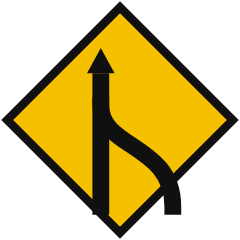
17. What does this sign warn a driver about?
Show answer
Answer A: Traffic from another roadway will enter the same lane ahead
Two traffic streams come together into one lane beyond this point, so drivers on both roadways have to adjust speed and spacing to fit together.
-
18. You need to leave the road and pull onto the shoulder. What should you check first?
Show answer
Answer A: Whether the shoulder surface is firm enough to support the motorcycle
Soft or loose shoulder material can grab the wheels or let the side stand sink, so confirm the surface is firm, signal, and then pull well clear of traffic.
-
19. You are already inside an intersection when you realize you should be in the lane beside you. What should you do?
Show answer
Answer C: Stay in your lane through the intersection and change lanes afterwards
Drivers in an intersection are watching for cross traffic and turning vehicles, so an unexpected sideways move there is easily missed.
-
20. The car ahead drifts across the lane line and back again several times. What should you do?
Show answer
Answer C: Assume that the driver is distracted or impaired, and keep well back
Drifting is a classic sign of a distracted, drowsy or impaired driver, and distance is your protection from all three.